Washington's Farewell by John Avlon
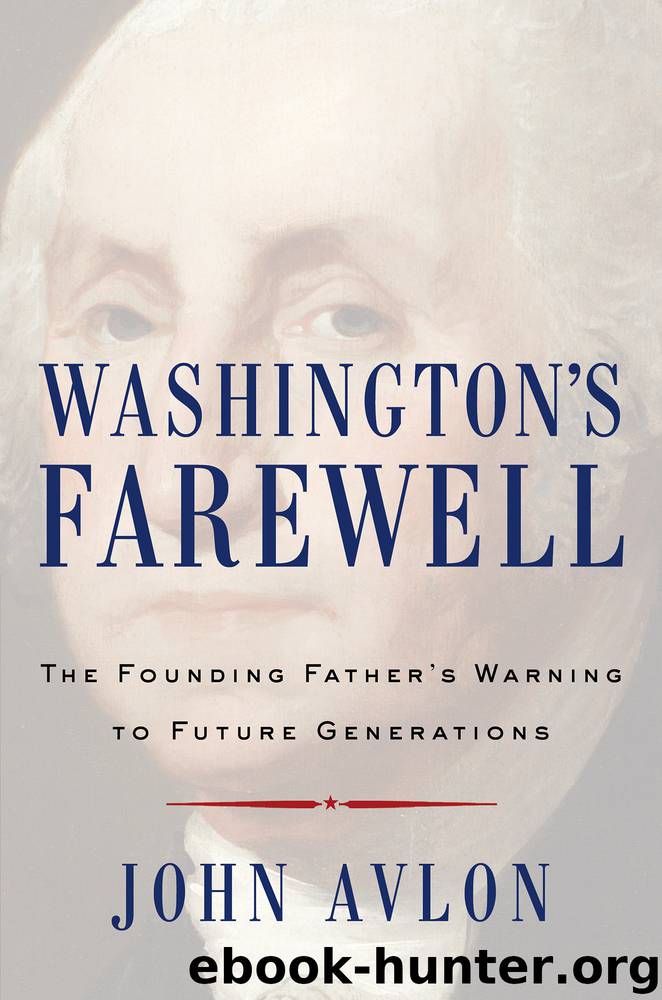
Author:John Avlon
Language: eng
Format: epub
Publisher: Simon & Schuster
IN THE END, WASHINGTON OUTMANEUVERED the Democratic-Republicans in Congress to pass the Jay Treaty, based largely on his personal prestige. “Nothing but his weight of character and reputation, combined with his firmness and political intrepidity, could have stood against the torrent,” John Quincy Adams remarked. “He is now pledged, and he is unmoved. If his system of administration now prevails, ten years more will place the United States among the most powerful and opulent nations on earth.”
But bitterness prevailed after the treaty passed. France was particularly unforgiving, and the French ambassador Pierre-Auguste Adet threw his most vocal advocate, Thomas Jefferson, under the carriage.
“Mr. Jefferson likes us because he detests England,” Adet sneered. “Although Jefferson is the friend of liberty and of science, although he is an admirer of the efforts we have made to cast off our shackles and to clear away the cloud of ignorance which weighs down the human race, Jefferson, I say, is an American, and as such he cannot sincerely be our friend. And America is the born enemy of all the peoples of Europe.”
Washington’s worldview retained a core healthy skepticism about the perfectibility of man as well as concern about the inevitable overreach that comes with the temptations of empire. This was a focus of his fears about foreign wars and their high cost in blood and treasure. Instead, he approached foreign policy with a spirit of global good citizenship, maintaining friendly terms with all, driven by the mutual self-interest that can come with commerce.
The Farewell Address is a response to the second-term crises that threatened those ideals. Beneath almost every phrase, you can hear echoes of domestic political debates between the Federalists and the Democratic-Republicans and their proxy states, England and France. But even Jefferson eventually flip-flopped and found religion on the subject, writing a few months after the Farewell’s publication, “Our countrymen have divided themselves by such strong affections to the French and the English, that nothing will secure us internally but a divorce from both nations. And this must be the object of every real American.”
It has been a common mistake for centuries to assume that the broad foreign policy principles Washington presented—specifically the principle of neutrality—was a de facto or explicit endorsement of isolationism. Washington’s immediate goal was to keep the United States out of foreign wars so that we might gain in strength and be free to pursue our own independent interests without being used as a pawn by Old World powers.
“If this country can remain in peace 20 years longer,” Washington wrote in the first draft of his 1796 Farewell, “such in all probability will be its population, riches, and resources, when combined with its peculiarly happy and remote situation from other corners of the globe, as to bid defiance, in a just cause, to any earthly power whatsoever.”
While Washington dropped that wording from the final Farewell Address, he kept the message intact: “The period is not far off when we may defy material injury from external annoyance; when
Download
This site does not store any files on its server. We only index and link to content provided by other sites. Please contact the content providers to delete copyright contents if any and email us, we'll remove relevant links or contents immediately.
| Africa | Americas |
| Arctic & Antarctica | Asia |
| Australia & Oceania | Europe |
| Middle East | Russia |
| United States | World |
| Ancient Civilizations | Military |
| Historical Study & Educational Resources |
Cat's cradle by Kurt Vonnegut(15279)
Pimp by Iceberg Slim(14451)
4 3 2 1: A Novel by Paul Auster(12344)
Underground: A Human History of the Worlds Beneath Our Feet by Will Hunt(12063)
The Radium Girls by Kate Moore(11989)
Wiseguy by Nicholas Pileggi(5727)
The Fire Next Time by James Baldwin(5399)
Perfect Rhythm by Jae(5372)
American History Stories, Volume III (Yesterday's Classics) by Pratt Mara L(5281)
Paper Towns by Green John(5150)
Pale Blue Dot by Carl Sagan(4969)
A Higher Loyalty: Truth, Lies, and Leadership by James Comey(4927)
The Mayflower and the Pilgrims' New World by Nathaniel Philbrick(4466)
The Doomsday Machine by Daniel Ellsberg(4464)
Killers of the Flower Moon: The Osage Murders and the Birth of the FBI by David Grann(4419)
The Sympathizer by Viet Thanh Nguyen(4359)
Too Much and Not the Mood by Durga Chew-Bose(4308)
The Borden Murders by Sarah Miller(4288)
Sticky Fingers by Joe Hagan(4156)
